
- Purpose of report
- The main aim of the report is to inform members of the Commission for Water Sustainability (CWS) who were not able to attend this conference on major topics discussed in sessions organised by our Commission as well as to provide relevant information regarding attendance, geographical coverage and other aspect that may be of interest. A second objective is to assist the Commission with archiving its scientific work as requested by IGU. To this end, this report will eventually be available on the website of the Commission (www.igu-water.org).
- Conference organisation
- 2.1 Preparatory phase
- Originally planned to take place in 2020 the LOC and IGU-Executive Committee, in April 2020, jointly decided to postpone the congress to August 2021 due to health risks and global travel restrictions related to the coronavirus pandemic. All registration fees paid, abstracts accepted, travel grants awarded, and sessions approved before this decision were carried over to 2021. As early as July 2019, the Commission had proposed the following themes as agreed at its annual meeting in Bucharest (Romania):
Water resource variability, monitoring, hydrological hazards and risk management
Proposed Chair: Prof. Frolova, Russia; Co-Chair: Prof. Zaharia, Romania
Key contents:
– hydrological processes: hydrograph analyses, run-off formation, climatic drivers, land use impacts etc.
– floods (long-term trends in magnitude and frequency, dynamics, risks and risk perception, prediction, reconstructing historical events etc.)
– droughts (natural and man-made causes, trends in magnitude and frequency, susceptibility, resilience, coping strategies etc.)
– water monitoring: observation networks, data availability, quality and accessibility
– mitigation strategies for extreme events
– hydrological processes in lakes, rivers, estuaries, groundwater, karst and soil
– integrated water resource management
- Human pressures on water: causes and consequences
Chair: Prof. He, USA, Co-Chair: Prof. Karthe, Mongolia
Key contents:
– human impacts on water availability: groundwater mining, dewatering of aquifers, irrigation, mining, industry, urbanisation, aquaculture, deforestation, urban agriculture, land use changes etc.
– surface water and ground water pollution, sediment pollution
– exposure pathways and associated risk analysis, pollution sources, mitigation strategies
– mobilisation and immobilisation of waterborne contaminants
– impacts on human health, ecosystems and habitats
– conventional and emerging contaminants (micro plastics etc.), geochemical mobility and environmental fate of waterborne contaminants, toxicity and bioavailability
– waste-water prevention and treatment
– waterborne diseases, sanitation issues, epidemiological/ medical geology studies
- Sustainable water use in the context of the water-energy-food nexus
Chair: Prof. Winde, Co-Chair: Prof. Canjevac
Key contents:
– causes and geographical patterns of water scarcity
– SDGs on water, energy and food: relations and interdependencies
– water overuse, water use efficiency, water consumption, water losses
– water use in energy generation and storage (cooling water, steam production, thermal pollution, emerging technologies …), water implications of renewable energy expansion and e-mobility
– energy use for water provision (desalination, pumping, conventional potabilization, recycling, waste-water treatment, sludge disposal …)
– water and energy for food: irrigation, horticulture, meat vs. crops
– embedded water, bottled water trade, virtual water trade
- Socio-economic aspects of water sustainability
Chair: Prof. Winde, Co-Chair: Prof. Frolova
Key contents:
– socio-economic drivers of water consumption, access to water,
– privatisation of water, water pricing, metered water
– leakage-related water loss, non-revenue water, mitigation strategies
– centralised vs. decentralised water supply and waste treatments
– national and international water conflicts and water collaboration
– cross boundary catchment management
– water access as a human right, SDG 6
- Methods in hydrological research
Chair: Prof. Karthe, Co-Chair: Dr. Kireeva
Key contents:
– Hydro-GIS, Virtual geographical environment,
– numerical modelling: groundwater, surface water, scale-dependent processes,
– remote sensing (satellites, drones etc.)
– crowd sourcing of hydrological data,
– big data, data transparency, raw data storage and sharing
- Water issues where Europe meets Asia: challenges and success stories in Turkey
Chair: Prof. Zaharia, Co-Chair: Prof. VS Yavuz
Key contents:
– focus is on real-world local water issues from a natural science or human sciences point of view preferably combining both views
– possible topics include drinking water quality and management in Turkey,
– water use and availability now and in future,
– dams and other large water projects,
– cross-boundary catchment management issues etc.
Endorsement letters
The Commission endorsed two applications of members for IGU travel grants through letters of support from the chair. While the online format obviously relieved participants from travel costs, registration fees of € 200-230 (early bird/ regular) and € 130-150 (students) had to be covered.
Our Commission supported application from Dr. Olutoyin A. Fashae (University of Ibadan, Nigeria) and Dr. Gabriela Moresanu (University of Bucharest, Romania). While both applications reportedly succeeded, only the latter presented at a session of our Commission.
Programme building
A novel feature introduced by the organising company of this congress (Dekon) was that Commission chairs were approached to assist with allocating time slots for their respective sessions using web-based programme-building software, which normally is done by the organisers themselves.
While the latter allocated papers to session themes, chairs could select date and time from remaining slots that had not yet been allocated. After a few initial glitches and repeated attempts we eventually succeeded in allocating all sessions to 7 x time slots spread over four days (17 to 20 August 2021) (Fig. 1).
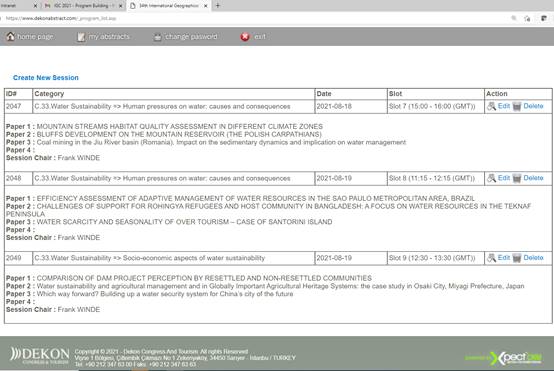
Fig. 1: Screen shot of the programme building software used
We would like to congratulate the organisers that parallel sessions of the same Commission were avoided relieving interested participants to choose between them. Especially for smaller Commissions this often results in significantly reduced audiences per session hampering personal interaction among smaller research communities. We would thus encourage IGU to keep this system in place for future meetings.
2.2 Video-conferencing
The congress organisers used Zoom as online platform for the conference, which generally worked well. In each session, dedicated and competent support staff was on stand-by for technical assistance.
As a backup for presenters experiencing poor connectivity during their talk or potential no shows, all speakers were requested to provide recordings of their papers to the organisers prior to the conference.
Papers presented as pre-recordings do usually not allow for subsequent questions as the authors are not present in the session. In one case, however, authors chose to use the pre-recording due to poor connectivity and were thus still able to engage in the subsequent discussion.
Generally, the technology worked well as all participant seemed to be familiar with the software – perhaps a result of more than a year of practising online meetings.
Many felt, however, that the 10 minutes limit for talks were rather short and where possible session chairs extended this to 20 minutes in cases where only three papers were scheduled for a 60-minutes session.
An unintended, positive side effect of the tight time limit may have been that time keeping was exceptionally good so that chairs did not have to intervene on a single occasion.
- Session themes
3.1 Session themes
Based on abstracts reviewed and approved by the SC the LOC eventually selected 24x papers for oral presentation only considering those authors that had registered and fully paid the conference fee.
The associated delay in finalising and releasing the programme posed a problem to members whose institutions required a scientific programme as part of funding applications. This, in turn, poses a challenge to organisers since they do not know for certain who of the registered participants will actually attend before payment arrives. This dilemma may need some attention when preparing for future meetings.
For our Commission the following three session themes were approved:
- Human pressures on water: causes and consequences
- 2 x sessions, 6 x papers
- Socio-economic aspects of water sustainability
- 1 x session, 4 x papers
- Water resource variability, monitoring, hydrological hazards and risk management
- 4 x sessions, 14 x papers.
Naturally, there is considerable overlap between the various session themes making allocation of papers to each session less than a clear-cut decision. As Geography prides itself to be one of the few scientific disciplines inherently able of bridging the gap between social and natural sciences the Commission made sure that a session dedicated to this integrated approach is included in the programme. It needs to be stressed though, that socio-economic aspects were implicit or explicit interwoven in many presentations of the other six sessions as well.
The complete list of all papers presented at our sessions including all authors and their affiliations was extracted from the Conference Programme augmented with information on the recorded number of attendees per session and the presentation mode used (life, pre-recording) for each paper (Appendix 1).
Furthermore, the organising company recorded all sessions making prior consent of participants a condition for joining a session. We assume that these recording will be made in due time.
3.2 Field trip and business meeting
Owing to the online format, no field trip could obviously be organised for this conference by local colleagues. Since field trips and excursions are always a highlight especially of our annual meetings it is hoped that conferences with physical presence will soon be possible again.
As no provision was made in the programme building software the Commission did not hold a business meeting during the conferences. Given that video-conferencing is now readily available at no costs such meetings can be organised as and when the need arises.
- Statistics
- Attendance of Commission members
Perhaps due to the postponement of the event, a general uncertainty on the effectiveness of an online events of this size and a rather late publication of the congress programme as well as Corona-related challenges, interest in participating in the event by Commission members was limited.
Eventually seven registered members of the Commission attended (4x from Russia, 1x Germany/South Africa, 2x from Romania representing ~13% of current membership) of which only two were part of the newly constituted SC. This is somewhat of concern as such low participation rate of leading members of the Commission rarely happened in the past.
Of the 24x papers presented at the seven sessions of our Commission 6x were presented by author/ co-author whom are members of the Commission accounting for a quarter of all papers.
All session were chaired by proffs. Natalia Frolova (4x) and Frank Winde (3x) both using the opportunity to repeatedly invite session participants to visit the Commission’s website and to consider joining the Commission.
4.2 Participation in online sessions
On average, each of our session attracted 14.3 online participants ranging from 8x to 19x (see Appendix 1). Changes of participation during the course of a session were only marginal.
Of the 24x papers 19x were presented life by authors (79%), 3x as pre-recorded video clips (12.5%) and 2x papers had to be cancelled (8%) since authors failed both, to attend and to provide back-up recording to the organisers beforehand.
4.3 Country representation
Based on author’s affiliation the following 21x countries were presented: Australia, Brazil, Bulgaria, Chile, China, France, Germany, Hungary, India, Japan, Kazakhstan, Nigeria, Poland, Romania, Russia, Slovenia, South Africa, Spain, UK, Turkey as well as two international organisations (Greenpeace, WHO/IARC). Somewhat surprising was the lack of representation of colleagues from North America.
Based on study areas the papers covered the following 18x countries, which are largely not but not fully identical with countries of the authors: Bangladesh, Brazil, Bulgaria, Chile, China, India, Japan, Kazakhstan, Mongolia, Nigeria, Poland, Romania, Russia, Slovenia, South Africa, Spain, Turkey as well as the European Union.
In line with previous observations, the country of author’s affiliation and the country of the study area are often identical for low to middle-income author countries while differing for high-income countries whose research institutions can often afford to conduct comparably expensive research outside of their home countries (Tab. 1).
Tab. 1: Comparing countries of author affiliation with countries of study area
(red – study country differs from home country)
| Country of author’s affiliation | Countries of study area |
| Australia | China |
| Brazil | Brazil |
| Bulgaria | Bulgaria |
| Chile | Chile |
| France | Romania, South Africa |
| Germany | Chile, South Africa |
| Hungary | Hungary, EU |
| India | Bangladesh, India |
| Japan | Japan, Bangladesh |
| Kazakhstan | Kazakhstan |
| Nigeria | Nigeria |
| Poland | Poland, China |
| Romania | Romania |
| Russia | Russia, Mongolia |
| Slovenia | Slovenia |
| South Africa | South Africa |
| Spain | Greece |
| Turkey | Turkey |
| UK | India |
In contrast to other IGU conferences where participants from the host country and from neighbouring countries usually account for the majority of speakers, this was not observed at this online event as distance-related travel cost did not restrict participation. With papers from/ on South America, Europe, Africa and Asia our sessions managed to achieve a significant degree of geographical coverage.
- Summary of sessions
Apart from the overarching session themes, the presented papers fall into somewhat broader categories used here to guide the following, decidedly non-exhaustive, overview on the scientific contents of the sessions.
5.1 Water availability
Under water availabilityare papers listed that address access to water under changing natural and anthropogenic conditions. Presented topics ranged from poor management of surface water reservoirs for the metropolitan agglomeration of Sao Paulo (Brazil) home to some 22 million people to precarious water supply in a refugee camp in Bangladesh, where people have to rely on unsafe rainwater captured in hand dug pits. It also includes the over-use of the limited water resources on the island of Santorini (Greece) by day tourists arriving via large cruise ships as well as over-pumping of groundwater in a semiarid basin of inner Anatolia (Turkey).
Highlighting the role of different natural condition between the alpine hinterland, karst regions and coastal plains a paper from Slovenia illustrated the divergent hydrological responses to changes in climatic conditions and land use ranging from increased flow in rivers draining karst areas (covering 43% of the country) to seasonal water shortages and even droughts in some coastal rivers. However, given its high rainfall (some 1600 mm/a) Slovenia, generally, can be regarded as a water-rich country.
In a paper from Poland, differences in public perceptions of dams in the Carpathians Mountains were studied, finding significantly lower acceptance levels among people that were resettled as part of the dam construction.
The crucial role of water availability for agriculture was explored in studies from India (West Bengal) and Japan, the latter introducing the perhaps lesser-known concept of GIAHS (General Interest Agricultural Heritage System). Another topical paper in this field addressing future water security in China as the most populous country of the world was, unfortunately, not presented due to a no show.
Describing high-tech facilities monitoring water derived from fog in the Atacama (Chile), a joint German-Chilean paper, explored the (very limited) availability of water in the world’s driest desert.
5.2 Water-related risks
Water-related risk usually fall into one of three categories: too much, too little or too dirty i.e. floods, droughts and pollution. For all three cases, papers were presented in our sessions.
The majority of papers addressed flooding risks with studies from Romania (as country with the highest number of fatalities within the EU), Bulgaria, China and Russia.
One paper studied impacts of pollution using hair of people exposed to uranium contaminated water and mine waste in and around the Johannesburg metropolitan area in South Africa.
Examples from the Baikal region in the Siberian part of Russia showed how increasing temperatures and droughts lead to growing incidences of peat fires. In how far the recently raging forest fires in Siberia are related to this cause can only be speculated on.
Generally, there appears to be consensus that most observed divergences of hydrological regimes from long-term patterns are caused by a combination of warming climates and human impacts such as changing land and water use etc.. This makes it often difficult to apportion weights to each factor especially in large catchments where significant areas are affected by urbanisation, agriculture, mining and industry.
As a means to mitigate water-related flooding risk hydrological modelling is a widely accepted tool of growing importance as examples from governmental flood prevention initiatives in Bulgaria, Romania, China, Kazakhstan and Russia illustrated. Supported by high number of participants it seems that flooding risks and related modelling is a clear focus of scientists within and outside our Commission. This needs to be considered in proposing sessions for the upcoming IGU conference in Paris 2022.
As all models are only as good as their input data the Hydrological Research Unit at the Faculty of Geography at Lomonosov Moscow State University developed a large data repository with associated map-building capacity that can be interrogated online free of charge. The cartographic web application titled “The Modern Water Regime of the Rivers in the European Part of Russia” is accessible via the following link: http://autolab.geogr.msu.ru/water-regime-etr/webapp.html. Google based browsers automatically can translate the Russian website into a language of your choice. The same unit also developed a publically accessible software tool for automatic hydrograph separation (GRWAT) that members are invited to use free of charge.
5.3 Water-energy nexus
The importance of addressing the water-energy nexus is perhaps best illustrated by the fact that the energy sector is responsible for 42% of all water abstractions in the EU amounting to some 74 bn m³/a (= 200,000 Ml/d) as pointed out in a paper from Hungary. This paper explored the intertwined relationship between water and energy in the context of coal power generation. It linked energy generation from coal to reduced groundwater availability through mining of coal and creating large dewatering cones as well as through groundwater pollution by contaminated seepage from coal-waste. Extended low-flow periods like the one experienced during 2018/19 pose a severe future risk to a large number of vulnerable coal-based power plants across a warming Europe, as cooling water from rivers may temporarily not be available.
In response to this a comment pointed out that, in Germany, coal power plants reportedly coped best with low-flow conditions at the time as they drew cooling water from nearby lakes of flooded former mine pits. In contrast, nuclear power plants had to be shut down when stream levels receded. The associated drop in power supply was exacerbated by a simultaneous drop in renewable power generation caused by a stationary high-pressure weather system. This resulted in an extended period with no wind and high temperatures that reduced the efficiency of PV panels. This reduced the input of wind and solar power at a time when energy demand for air conditioning sored. In that situation, blackouts were averted by coal-fired power plants in Eastern Germany, where flooded mining pits served as emergency cooling water reservoirs.
Impacts of coal mining-related pollution of river systems were investigated in a paper from Romania exploring how washed-off coal waste is transported downstream using alluvial sediments as an indicator.
A very direct impact of energy generation on water resources was reported from Lake Baikal in Siberia (Russia) illustrating how the operation of a hydroelectric energy plant at its only outflow point (Angara) superimposes natural fluctuations with an artificial regime of significantly increased amplitudes of lake level changes.
In the context of the earlier mentioned water-stress on Santorini island (Greece) the interdependency of water and energy also became apparent. There a growing number of energy-intense desalination plants is constructed to use seawater for supplementing local drinking water supply. In order to meet the associated energy demand wind and solar power plants are built on the islands. Landscapes dotted with ever-higher rising wind turbines, of which many older ones have meanwhile have fallen into disrepair, lose their scenic beauty and touristic attraction drying up tourism as the major source of income. At 32 million visitors per year tourism in Greece accounts for nearly a quarter of the national GDP with probably much higher proportions on the islands. While the decrease in tourism could also be viewed as a negative feedback loop preventing total collapse of affected ecosystems, it is likely to have devastating effects on local communities. It may mark the completion of a cycle known from other touristic areas worldwide where the uncontrolled growth of tourism finally destroyed the very natural beauty it was once built on.
Admittedly, I was among those that initially were somewhat sceptical as to what extent an online event can meaningfully substitute a physical meeting of that size. However, the congress we just experienced proved that online conferences do have value.
(6) Concluding remarks
Advantages of online formats include, inter alia, attendance with no travel costs, which could in future help to overcome shortages of funds by members from resource-restricted institutions. Other advantages are the option of video back-ups for no shows, a somewhat reduced number of no shows (less travel and visa uncertainties) and the easy recording of sessions for archiving purposes. In addition, the pre-recording of presentations allows authors to attend where time clashes would otherwise make participation impossible. An associated drawback of this is the fact that no questions can be asked to presenters. Moreover, there is a risk of possible abuse for convenience reasons and of squeezing as many papers into a single conference as possible as physical presence is not required. Disadvantages of online conferences include the lack of coffee-break conversations and networking as well as personal chats with friends and colleagues. I also perceive presenting without eye contact to the audience and the associated visual feedback as awkward often making talks less engaging. Another drawback is of course the obvious lack of field trips that usually facilitate fruitful exchange of ideas among members who are spending quality time together. For future meetings we should explore what elements of video-conferencing could be used for complementing (yet not replacing) meetings in person.
Appendix 1
Augmented Scientific Programme of the Commission for Water Sustainability
(blue: information added by FW, bold names: members of CWS, blue names: life presenter,
1121 – Paper by members of Commission)
Tue., 17.08.2021
| 15:00 – 16:00 | Slot 7 Parallel Sessions | C.33.Water Sustainability => Human pressures on water: causes and consequences | Room: Carl Troll |
| TRACK: C.33.WATER SUSTAINABILITY => HUMAN PRESSURES ON WATER: CAUSES AND CONSEQUENCES Chairperson: Frank Winde No. of attendees (max.): 14 x Papers: 1078 – MOUNTAIN STREAMS HABITAT QUALITY ASSESSMENT IN DIFFERENT CLIMATE ZONES (pre-recorded presentation) Lukasz Wiejaczka – INSTITUTE OF GEOGRAPHY AND SPATIAL ORGANIZATION Małgorzata Kijowska-Strugała – INSTITUTE OF GEOGRAPHY AND SPATIAL ORGANIZATION Jarosław Cebulski – INSTITUTE OF GEOGRAPHY AND SPATIAL ORGANIZATION Eliza Płaczkowska – INSTITUTE OF GEOGRAPHY AND SPATIAL ORGANIZATION Zofia Rączkowska – INSTITUTE OF GEOGRAPHY AND SPATIAL ORGANIZATION Paweł Prokop – INSTITUTE OF GEOGRAPHY AND SPATIAL ORGANIZATION Qiang Zou – CHINESE ACADEMY OF SCIENCES, INSTITUTE OF MOUNTAIN HAZARDS AND ENVIRONMENT Yongqiang Guo – CHINESE ACADEMY OF SCIENCES, INSTITUTE OF MOUNTAIN HAZARDS AND ENVIRONMENT Jiang Hu – SOUTHWEST UNIVERSITY OF SCIENCE AND TECHNOLOGY 1099 – BLUFFS DEVELOPMENT ON THE MOUNTAIN RESERVOIR (THE POLISH CARPATHIANS) (pre-recorded presentation) Malgorzata Kijowska-strugala – INSTITUTE OF GEOGRAPHY AND SPATIAL ORGANIZATION POLISH ACADEMY OF SCIENCES Łukasz Wiejaczka – INSTITUTE OF GEOGRAPHY AND SPATIAL ORGANIZATION POLISH ACADEMY OF SCIENCES Jarosław Cebulski – INSTITUTE OF GEOGRAPHY AND SPATIAL ORGANIZATION POLISH ACADEMY OF SCIENCES 2351 – COAL MINING IN THE JIU RIVER BASIN (ROMANIA). IMPACT ON THE SEDIMENTARY DYNAMICS AND IMPLICATION ON WATER MANAGEMENT (life presentation) Gabriela Adina Morosanu – ROMANIAN ACADEMY Liliana Zaharia – UNIVERSITY OF BUCHAREST Philippe Belleudy – UNIVERSITY OF GRENOBLE ALPES Eugen Traistă – UNIVERSITY OF PETROSANI Mihaela Sima – ROMANIAN ACADEMY Jurchescu Marta – ROMANIAN ACADEMY Irena Mocanu – ROMANIAN ACADEMY Bianca Mitrică – ROMANIAN ACADEMY | |||
Screen shot of the above session (credit: Natalia Frolova)
Wed. 18.8.21
| 11:15 – 12:15 | Slot 8 Parallel Sessions | C.33.Water Sustainability => Human pressures on water: causes and consequences | Anne Buttimer | |
| TRACK: C.33.WATER SUSTAINABILITY => HUMAN PRESSURES ON WATER: CAUSES AND CONSEQUENCES Chairperson: Frank Winde No. of attendees (max.): 18 x Papers: 2362 – EFFICIENCY ASSESSMENT OF ADAPTIVE MANAGEMENT OF WATER RESOURCES IN THE SAO PAULO METROPOLITAN AREA, BRAZIL (life presentation) Leandro Fernandes Miyazaki – UNIVERSITY OF SAO PAULO Luis Antonio Bittar Venturi – UNIVERSITY OF SAO PAULO 3039 – CHALLENGES OF SUPPORT FOR ROHINGYA REFUGEES AND HOST COMMUNITY IN BANGLADESH: A FOCUS ON WATER RESOURCES IN THE TEKNAF PENINSULA (life presentation) Khan Shakil – CHUBU MANUFACTURING Ai Sugie – NAGOYA UNIVERSITY 3218 – WATER SCARCITY AND SEASONALITY OF OVER TOURISM – CASE OF SANTORINI ISLAND (life presentation) Itri Atay – ROVIRA I VIRGILI UNIVERSITY Barış Seyhan – ROVIRA I VIRGILI UNIVERSITY  Screen shot of the above session (credit: Natalia Frolova) Screen shot of the above session (credit: Natalia Frolova) | ||||
| 12:30 – 13:30 | Slot 9 Parallel Sessions | C.33.Water Sustainability => Socio-economic aspects of water sustainability | Akin L. Mabogunje | |
| TRACK: C.33.WATER SUSTAINABILITY => SOCIO-ECONOMIC ASPECTS OF WATER SUSTAINABILITY Chairperson: Frank Winde No. of attendees (max.): 10 x Papers: 1083 – COMPARISON OF DAM PROJECT PERCEPTION BY RESETTLED AND NON-RESETTLED COMMUNITIES (pre-recorded presentation) Lukasz Wiejaczka – INSTITUTE OF GEOGRAPHY AND SPATIAL ORGANIZATION Danuta Piróg – PEDAGOGICAL UNIVERSITY OF CRACOW Joanna Fidelus-orzechowska – PEDAGOGICAL UNIVERSITY OF CRACOW 2397 – WATER SUSTAINABILITY AND AGRICULTURAL MANAGEMENT AND IN GLOBALLY IMPORTANT AGRICULTURAL HERITAGE SYSTEMS: THE CASE STUDY IN OSAKI CITY, MIYAGI PREFECTURE, JAPAN (life presentation) Masatoshi Motoki – TOKIWA UNIVERSITY Toru Sasaki – MIYAGI UNIVERSITY OF EDUCATION 2874 – WHICH WAY FORWARD? BUILDING UP A WATER SECURITY SYSTEM FOR CHINA’S CITY OF THE FUTURE (no show) Wenjing Zhang – UNIVERSITY OF MELBOURNE 2009 – THE ROLE OF COAL IN THE WATER-ENERGY-FOOD NEXUS (life presentation) Csaba Vaszkó – GREENSTREAMS; SZENT ISTVÁN UNIVERSITY Jai Krishna – GREENPEACE | ||||
| 15:00 – 16:00 | Slot 10 Parallel Sessions | C.33.Water Sustainability => Water resource variability, monitoring, hydrological hazards and risk management | Anne Buttimer |
| TRACK: C.33.WATER SUSTAINABILITY => WATER RESOURCE VARIABILITY, MONITORING, HYDROLOGICAL HAZARDS AND RISK MANAGEMENT Chairperson: Natalia Frolova No. of attendees (max.): 8 x Papers: 1161 – CLIMATE CHANGE IMPACTS ON ADRIATIC SEA BASIN RIVERS IN SLOVENIA (life presentation) Gregor Kovačič – UNIVERSITY OF PRIMORSKA Valentina Brečko Grubar – UNIVERSITY OF PRIMORSKA 1483 – PREDICTING ENVIRONMENTAL UPTAKE OF MINING-RELATED URANIUM: USING HUMAN SCALP HAIR AND A VGE-BASED EXPOSURE MODEL (life presentation) Frank Winde – WISMUT GMBH Emile Hoffmann – NORTH-WEST UNIVERSITY Gerhard Geipel – HZDR Joachim Schüz – IARC 1553 – MODERN WATER REGIME OF THE RIVERS OF THE EUROPEAN TERRITORY OF RUSSIA AND ITS MAPPING (life presentation) Natalia Frolova – LOMONOSOV MOSCOW STATE UNIVERSITY Maria Kireeva – LOMONOSOV MOSCOW STATE UNIVERSITY Timofey Samsonov – LOMONOSOV MOSCOW STATE UNIVERSITY Andrey Entin – LOMONOSOV MOSCOW STATE UNIVERSITY Aleksey Sazonov – LOMONOSOV MOSCOW STATE UNIVERSITY Vladimir Semin – LOMONOSOV MOSCOW STATE UNIVERSITY Elena Povalishnikova – LOMONOSOV MOSCOW STATE UNIVERSITY Vadim Grigor’ev – LOMONOSOV MOSCOW STATE UNIVERSITY Maksim Kharlamov – LOMONOSOV MOSCOW STATE UNIVERSITY | |||
Thu., 19.08.2021
| 11:15 – 12:15 | Slot 11 Parallel Sessions | C.33.Water Sustainability => Water resource variability, monitoring, hydrological hazards and risk management | Roland J. Fuchs |
| TRACK: C.33.WATER SUSTAINABILITY => WATER RESOURCE VARIABILITY, MONITORING, HYDROLOGICAL HAZARDS AND RISK MANAGEMENT Chairperson: Natalia Frolova No. of attendees (max.): 19 x Papers: 2342 – RESPONSE OF GLOBAL CLIMATE CHANGE ON THE GREAT ASIAN WATERSHED TERRITORY (life presentation) Alexander Ayurzhanaev – LABORATORY OF GEOECOLOGY Endon Garmaev – LABORATORY OF GEOECOLOGY 2493 – CLIMATIC AND ANTHROPOGENIC INFLUENCE ON FRESHWATER AVAILABILITY FOR AGRICULTURE IN THE SUNDARBANS REGION OF WEST BENGAL, INDIA (life presentation) Alexandre Gagnon – LIVERPOOL JOHN MOORES UNIVERSITY Lalu Das – BIDHAN CHANDRA KRISHI VISWAVIDYALAYA Gautam Saha – BIDHAN CHANDRA KRISHI VISWAVIDYALAYA 2542 – RAIN AND THAW PEAK-FLOW ON THE RIVERS OF RUSSIAN PLAIN IN XX-XXI CENTURY (life presentation) Maria Kireeva – LOMONOSOV MOSCOW STATE UNIVERSITY Ekaterina Rets – WATER PROBLEM INSTITUTE, RAS Timophey Samsonov – LOMONOSOV MOSCOW STATE UNIVERSITY Natalia Frolova – LOMONOSOV MOSCOW STATE UNIVERSITY Andrey Entin – LOMONOSOV MOSCOW STATE UNIVERSITY 2884 – A NEW MULTIPLE RETURN-PERIOD MODEL OF FLOOD REGULATION SERVICE—A CASE STUDY IN YANGTZE RIVER BASIN (life presentation) Ju Shen – SHANGHAI NORMAL UNIVERSITY Shiqiang Du – SHANGHAI NORMAL UNIVERSITY | |||
Screen shot of the above session (credit: Natalia Frolova)
| 12:30 – 13:30 | Slot 12 Parallel Sessions | C.33.Water Sustainability => Water resource variability, monitoring, hydrological hazards and risk management | Jean Dresch |
| TRACK: C.33.WATER SUSTAINABILITY => WATER RESOURCE VARIABILITY, MONITORING, HYDROLOGICAL HAZARDS AND RISK MANAGEMENT Chairperson: Natalia Frolova No. of attendees (max.): 17 x Papers: 1861 – FLOOD RISK MANAGEMENT IN ROMANIA: WAYS AND ACTIONS FOR PUBLIC INFORMING. FROM LEGISLATION, TO PRACTICE (life presentation) Liliana Zaharia – UNIVERSITY OF BUCHAREST, FACULTY OF GEOGRAPHY Gabriela Ioana-Toroimac – UNIVERSITY OF BUCHAREST, FACULTY OF GEOGRAPHY 1949 – QUANTITATIVE ANALYSIS OF THE AREAL AND RELIEF PROPERTIES OF ASU RIVER BASIN, SOUTHEAST NIGERIA. (no show) Precious Chidera Igboanugo – NNAMDI AZIKIWE UNIVERSITY, AWKA, NIGERIA Emma Emeka Ezenwaji – NNAMDI AZIKIWE UNIVERSITY, AWKA, NIGERIA Chukwudi Peter Nzoiwu – NNAMDI AZIKIWE UNIVERSITY, AWKA, NIGERIA 1952 – LOCAL SPATIO-TEMPORAL FOG WATER AVAILABILITY AND GRADIENTS IN THE NORTHERN CHILEAN COASTAL ATACAMA DESERT (life presentation) Juan Carlos Pastene – DEPARTMENT OF GEOGRAPHY – RESEARCH GROUP FOR EARTH OBSERVATION Alexander Siegmund – DEPARTMENT OF GEOGRAPHY – RESEARCH GROUP FOR EARTH OBSERVATION Camilo Del Río – INSTITUTO DE GEOGRAFÍA & CENTRO DESIERTO DE ATACAMA, Pablo Osses – INSTITUTO DE GEOGRAFÍA & CENTRO DESIERTO DE ATACAMA, 2117 – THE USE OF MODELING FOR EVIDENCE-BASED PLANNING TO DEAL WITH THE POSSIBLE CONSEQUENCES OF SPRING FLOODS ON LOWLAND RIVERS (life presentation) Farida Akiyanova – INTERNATIONAL SCIENCE COMPLEX “ASTANA” Nurlan Ongdas – INTERNATIONAL SCIENCE COMPLEX “ASTANA” Yergali Karakulov – INTERNATIONAL SCIENCE COMPLEX “ASTANA” Altynay Shaimerdenova – INTERNATIONAL SCIENCE COMPLEX “ASTANA” Zhanbota Mussagaliyeva – INTERNATIONAL SCIENCE COMPLEX “ASTANA” Nurlybek Zinabdin – INTERNATIONAL SCIENCE COMPLEX “ASTANA” Aksholpan Atalikhova – INTERNATIONAL SCIENCE COMPLEX “ASTANA” Adlet Nazhbiyev1 – INTERNATIONAL SCIENCE COMPLEX “ASTANA” Arman Kabdeshev1 – INTERNATIONAL SCIENCE COMPLEX “ASTANA” Aliya Simbatova – INTERNATIONAL SCIENCE COMPLEX “ASTANA” | |||
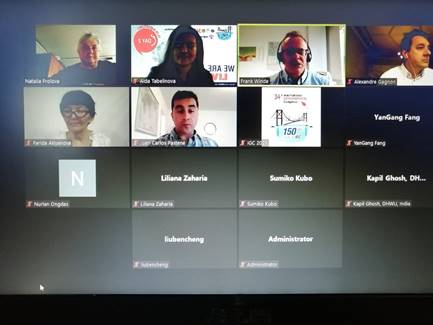
Screen shot of the above session (credit: Natalia Frolova)
Fri., 20.08.2021
| 1:15 – 12:15 | Slot 13 Parallel Sessions | C.33.Water Sustainability => Water resource variability, monitoring, hydrological hazards and risk management | Yukio Himiyama |
| TRACK: C.33.WATER SUSTAINABILITY => WATER RESOURCE VARIABILITY, MONITORING, HYDROLOGICAL HAZARDS AND RISK MANAGEMENT Chairperson: Natalia Frolova No. of attendees (max.): 14 x Papers: 2886 – NEW DATASET REVEALING LOWER FLOOD PROTECTION FOR VULNERABLE POPULATION IN CHINA (life presentation) Dan Wang – SHANGHAI NORMAL UNIVERSITY Paolo Scussolini – VRIJE UNIVERSITEIT AMSTERDAM Shiqiang Du – SHANGHAI NORMAL UNIVERSITY Jiahong Wen – SHANGHAI NORMAL UNIVERSITY Ruishan Chen – EAST CHINA NORMAL UNIVERSITY 3387 – GROUNDWATER LEVEL CHANGES AND HYDROLOGICAL DROUGHT ANALYSIS IN KONYA ENDORHEIC BASIN (life presentation) Furkan Gedik – ÇANAKKALE ONSEKIZ MART UNIVERSITY Faize Sarış – ÇANAKALE ONSEKIZ MART UNIVERSITY 3426 – MODELING FLOOD REGULATION IN SUPPORT OF ECOSYSTEM ACCOUNTING IN BULGARIA (life presentation) Stoyan Nedkov – NATIONAL INSTITUTE OF GEOPHYSICS, GEODESY AND GEOGRAPHY GEOGRAPHY Petar Nikolov – NATIONAL INSTITUTE OF GEOPHYSICS, GEODESY AND GEOGRAPHY GEOGRAPH Desislava Hristova – NATIONAL INSTITUTE OF GEOPHYSICS, GEODESY AND GEOGRAPHY GEOGRAPH Hristina Prodanova – NATIONAL INSTITUTE OF GEOPHYSICS, GEODESY AND GEOGRAPHY GEOGRAPH | |||
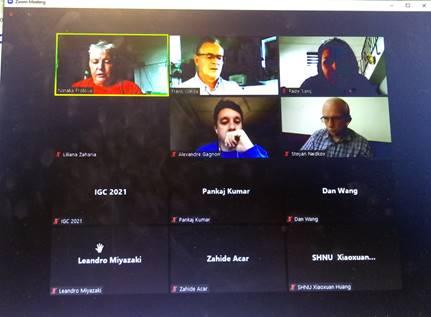
Screen shot of the above session (credit: Frank Winde)
 IGU Commission for Water Sustainability