
The 2019 Annual Meeting of the Commission was titled: “Water sustainability in a changing world” and hosted by the Faculty of Geography of the University of Bucharest. It was jointly supported by the Research Institute of the University of Bucharest (ICUB), the Research Centre “Water resources and water-related risk management (GRARH) and the Institute of Geography of the Romanian Academy (IGAR).
The conference was organised under the leadership of Prof. Liliana Zaharia supported by colleagues and post-graduate student volunteers from the Department of Meteorology – Hydrology of the Faculty of Geography.
The international scientific committee and local organising committee comprised members of the Commission, the Academy of Romania, Romanian universities and research institutes and, importantly, practioners from various organisations such as the National Administration of Romanian Waters and the National Institute of Hydrology and Water Management adding applied aspects to the meeting.
Prof. Zaharia also succeeded in soliciting support by the Vice Rector of the Bucharest University and the Vice Dean delivering opening addresses. The conference was also honoured by Prof. Fu, President of the Geographical Society of China, addressing the participants in his capacity as liaison-officer of the IGU Executive Committee to our Commission.
The Chair, in his opening address, elaborated on the need for a geographical water commission stressing the need for an integrated approach to complex water issues that employs the specific strengths of Geographers in adopting insights and tools of neighbouring sciences to arrive at new and holistic views rather than further increasing compartmentalisation of water sciences. In doing so the Commission actively encourages membership also of non-Geographers working on water and its sustainable use as well as of practioners as ultimate recipients of scientific solutions.
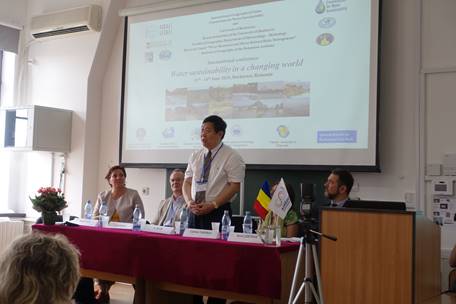
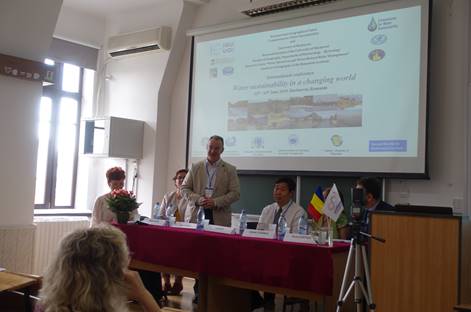
Opening addresses by Proffs. Fu (upper photo) and Winde (Photos: Prof. Frolova)
In addition to the thematic sessions on days one and two an excursion on urban hydrological engineering and a two-day field trip on Carpathian mountain hydrology formed part of the conference programme.
All participants received a comprehensive collection of supporting documents including printed and digital versions of the conference programme, a book of abstracts as well as two most informative guides on the two field trips indicating thoroughness and attention to detail of the organisers.
Prof. Zaharia also managed to attract local financial support of the conference to supplement accommodation costs, providing additional material for the conference bag and keeping fees at a minimum. The good quality of the catering and the grand location of the gala dinner deserve special recognition in this context.
In summary, the Chair and the members of the SC of the Commission would like to express their sincere gratitude towards all involved in preparing and hosting a scientifically sound and professionally organised meeting that was most enjoyable.
We especially wish to thank Prof. Zaharia, her husband as well as her PhD-student Gabriela Moresanu for providing members with such a memorable event.
(ii) Sessions, presentations and field trip
In five sessions spread over two fully packed days a total of 15 oral presentations (one no show) and 11 posters were presented, with the authors of the latter introducing their work in a 5 to 15 minutes talk. The topics of the thematic sessions in chronological order were:
- Keynote addresses
- Water resource variability in a changing environment and hydrological hazards and related risks management
- Human pressure and impacts on hydro-systems and water resources, monitoring and sustainable water management
- Poster session
- Methodology in hydrological research: GIS, modelling, remote sensing
Topics addressed ranged from analysing hydrological processes in rivers in the context of changing environments with example from Russia, flood risks and predictions for rivers in Romania, human impacts on water quality and flow associated with global mining activities and urbanisation as well as the use of advanced satellite technology to assess water budgets on earth. Cross cutting topics that managed to fuse natural and social research methodologies were also presented with examples from flood risks of Romanian rivers, the reconstruction of historical floods from archives as well as water management practices on ocean cruise ships. The comparative advantages of Geographers over competitors in the field of stream morphology assessments were explored by Prof. Canjevac based on personal experiences in Croatia.
Geographically, the presented research ranged from the global scale (GRACE and soil water satellites, mining) to regional and local approaches covering study areas in Romania (as host country naturally dominating the conference), Russia, Croatia, Uzbekistan, China, Germany and France as well as the extreme latitudes of the Arctic and Antarctic. Presenting members hailed from Canada, Croatia, China, France, Russia, Slovakia, South Africa, USA and different provinces of Romania including Muntenia/ Wallachia, Transylvania and Moldavia.
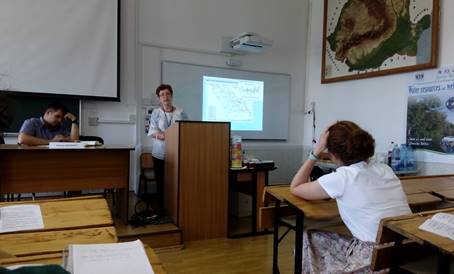
Prof. Zaharia and her attentive audience (Photos: F. Winde)
As mentioned above, two field trips were offered a half-day trip on urban hydrological engineering of the Colentia River in Bucharest and a two-day trip on Carpathian mountain hydrology, both supported by dedicated well-illustrated study guides.
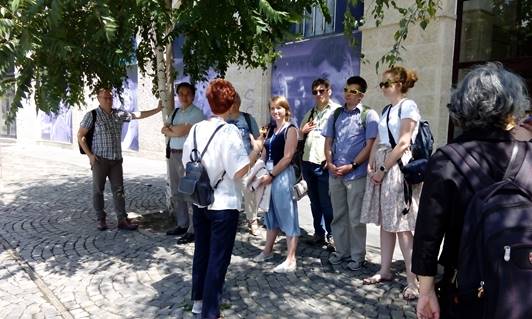
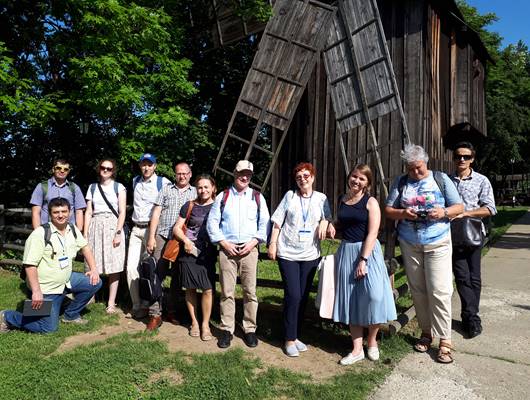
Urban hydrology and city excursion
As part of the 2-day field trip that addressed issues pertaining to “Human pressures on hydrosystems: the example of the Arges watershed” (Day 1) we were received by the local agency responsible for raw water provision, flood protection and water monitoring in Pitesti, which not only received us warmly with snacks and gifts but also patiently answered the many questions we had after the introductory presentation. Subsequently we visited the Vidraru Dam near Curtea de Arges (Muntenia province) constructed from 1960 to 1966 whose 166-m-high concrete arch wall dams the Arges River generating 220 MW of hydropower as its primary purpose using 4 Francis turbines located underground in a 42-km-long tunnel system.
Endowed with plentifully water and a mountainous topography Romania has another 14 large hydroelectric power stations. The abundance of water may also account for an exceptionally low price at which raw water is sold by the Arges Water Agency to municipal drinking water utilities quoted to us as just LEI 60/ Ml (LEI 0.06 per m³; ~ €-cent 1.2 per m³).
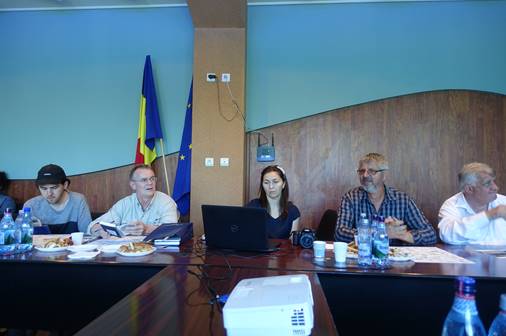
At the Arges River water agency in Pitesti (Photo: N. Frolova)
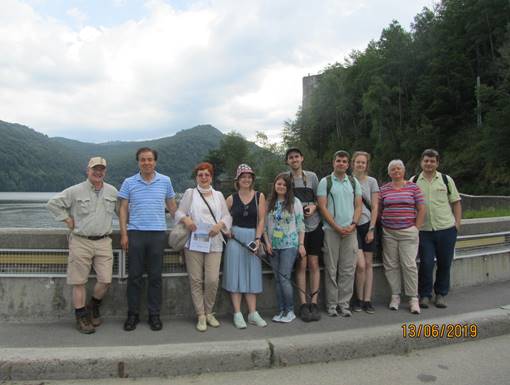
On the 166-m-high dam wall of the Vidraru dam (Photo: L. Zaharia)
After a very interesting and long first day and an excellent stay-over at the Vila Bran Mountain Resort (near ‘Dracula’s castle’) we visited Brasov located in an inner Carpathian depression and then crossed into the neighbouring watershed of the Dambovita River that flows towards Bucharest to where we safely returned in the evening filled with exciting memories. Along the way we also visited Romania’s first hydroelectric power plant, built in 1884, using flowing water for powering the nearby residence of the royal family in Sinaia.
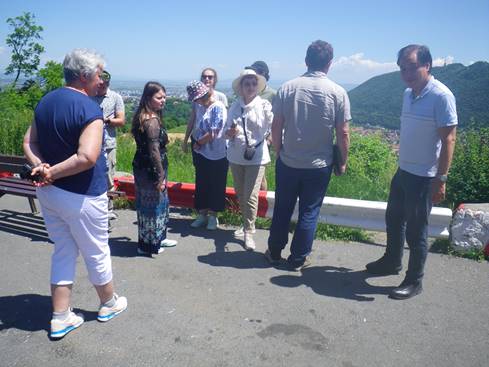
2nd day of the field trip: looking onto scenic Brasov (Transylvania)
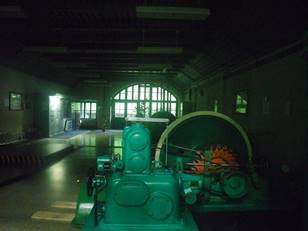
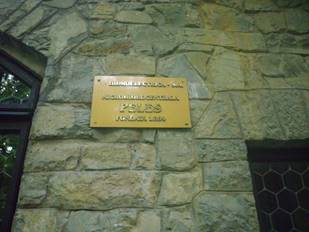
The historical hydroelectric power plant at Sinaia
2 Business Meeting 2019
On the second day of the conference the annual business meeting of the Commission was held addressing the following agenda points:
- Membership development
- Joint publication/ Hydrogeography book project
- Hydrological glossary project
- Session proposals for IGC Istanbul 2020
- Miscellaneous
Outcomes:
(i) Membership: In contrast to earlier years where membership grew by simply adding email-addresses of conference participants to the distribution list the Commission now requires specifically developed templates capturing research interests and professional profiles to be submitted before membership is conferred to applicants. In this way active participation is encouraged as only members with interest in the work of the Commission tend to submit the required information. Furthermore, by displaying member profiles on the website direct collaboration among members working in specific fields is facilitated even attracting interest from non-members visiting the website. Together with the comprehensive overhaul of the website design and content (still in progress) this may explain that the Commission now ongoingly receives unsolicited applications for membership helping to broaden geographical representivity and the member base of the Commission. As of 20 June 2019, the Commission has a total of 57 registered members representing six continents.
(ii) Joint publication: Following the Quebec meeting 2018 different options for a joint Commission publication were explored including special issues of established journals as well as a book on Hydrogeography as proposed by Prof. Karthe. After a brief discussion the meeting agreed with a proposal by Prof. Natalia Frolova to publish a special issue in the Scopus-indexed journal: Geography, Environment, Sustainability (https://ges.rgo.ru/jour) based on a selection of papers presented in Quebec (2018) and Bucharest (2019). As preliminary working title directing the type of submission the following is proposed: “Water sustainability: geographic perspectives based on international case studies”. The intention of the special issue is briefly described below (first draft):
As a follow-up of recent conferences of the IGU Commission for Water Sustainability in Quebec (2018) and Bucharest (2019) we propose the compilation of a special issue dedicated to studies of water-related challenges in different geographical environments ranging from climate-induced hydrological extreme events in the arctic circle to man-made impacts on water quality and availability through urbanization, irrigation, mining and deforestation in arid and semiarid areas of Africa, Europe and Asia addressing the water-energy-food nexus to the development of hydrological methods and tools encompassing latest remote sensing technology, GIS and numerical modelling. Based on case studies from Russia, China, South Africa, Central and Eastern Europe and Antarctica and other areas the issue aims to promote integrated transdisciplinary approaches to water sustainability from different water-related disciplines including Physical and Human Geography, Civil Engineering, Biology, Sedimentology and others. By transcending disciplinary boundaries and limitations the special issue aims at arriving at an improved understanding of how the complex interplay between natural and anthropogenic factors impacts on the sustainable use of water as a renewable yet increasingly scarce resource.
We encourage members to offer suggestions for thematic focal points and the title of the special issue via email (frank.winde@nwu.ac.za; frolova_nl@mail.ru).
Once details on the actual topics and format requirements are agreed upon with the publisher members will be asked to submit manuscripts.
(iii) Hydrological online glossary: Recognising that there are at least two online multilingual hydrology glossaries already in existence it was proposed that any further work should focus on a wiki-platform type of format that allows expanding and updating of entries. However, this will require a longer-term commitment which needs to be assured before the Commission can embark on the project.
 IGU Commission for Water Sustainability